Speed to Lead for Small Business: Why Seconds Decide Sales
There is a number every business owner has heard at some point: 78% of customers buy from whoever replies first. It gets quoted in sales decks, on LinkedIn, and in roughly every article about response times.
We went looking for where it came from. It does not have a source. It appears in neither of the two studies it is usually credited to. Somebody wrote it down, everyone else copied it, and now it is folklore.
That is a bad start for an article about speed to lead, so let us do this properly instead. Speed to lead for a small business is one of the few things in sales where the real research is unusually clear, and the honest version of the numbers is more useful than the invented one. Below is what the studies actually measured, where they are weaker than people claim, and what the findings mean for a business in India answering enquiries from a phone.
What is speed to lead, and why does it matter?
Speed to lead is the time between someone enquiring and you responding. Research consistently finds it is one of the strongest predictors of whether that enquiry becomes a customer, because buying intent decays within minutes, not days. Most businesses respond in hours, which is why replying fast is such an unusually cheap advantage.
What the research actually says
Two studies do almost all the work here, and they get confused with each other constantly.
The 2007 Lead Response Management study. Dr James Oldroyd, then a research fellow at MIT Sloan, analysed InsideSales.com platform data covering three years, six companies, more than 15,000 leads and over 100,000 call attempts. The finding: calling a web lead within 5 minutes rather than 30 minutes raised the odds of reaching that person by about 100 times, and the odds of qualifying them by about 21 times.
Worth being straight about the caveat, since almost nobody quotes it: this was vendor data with academic analysis, not a peer-reviewed MIT publication. The effect is large and repeatedly replicated, but it is not the "MIT study" it gets called.
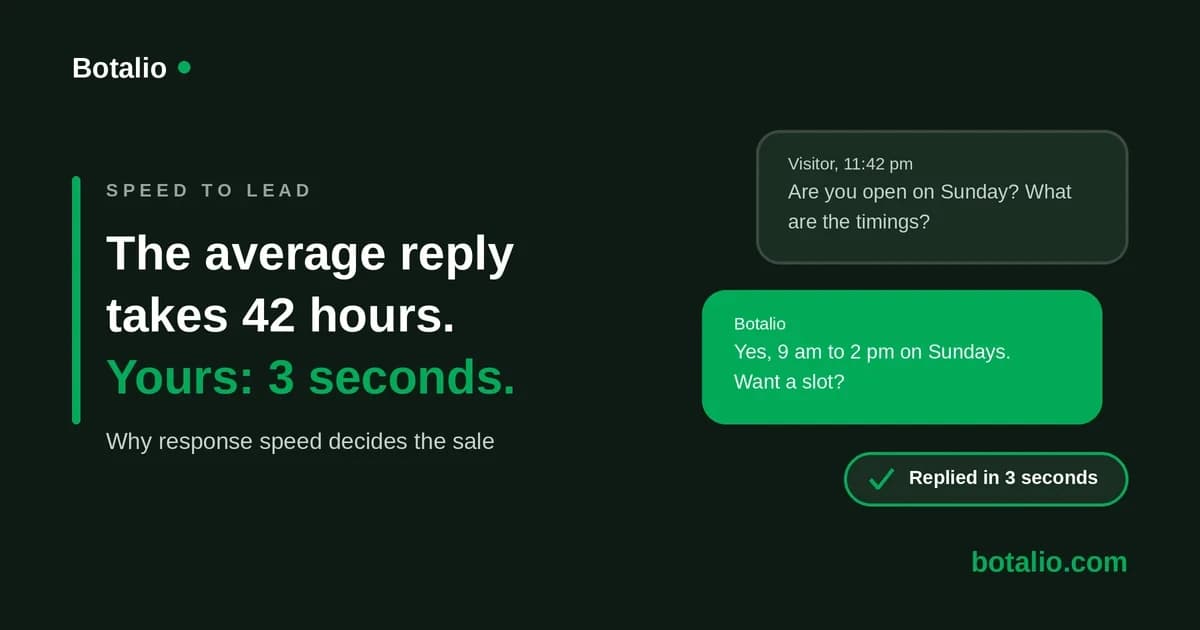
The 2011 Harvard Business Review audit. Oldroyd, McElheran and Elkington audited 2,241 US companies by sending each a web enquiry and timing the reply. 37% responded within an hour. 24% took more than a day. 23% never responded at all. Among those that did respond within 30 days, the average was 42 hours. Firms attempting contact within an hour were nearly 7 times more likely to have a meaningful conversation with a decision maker than those waiting a single hour longer, and more than 60 times more likely than those waiting a day.
Has anything changed since? Not really. A 2024 audit of 1,000 B2B SaaS companies found 63.5% never replied to a demo request at all, and those that did averaged over a day. A separate 2024 audit of 114 companies found average email response just under 12 hours and average phone callback around 14 and a half hours.
| Study | Sample | Headline finding |
|---|---|---|
| Lead Response Management, 2007 | 15,000+ leads, 100,000+ calls | 5 min vs 30 min: 100x contact odds, 21x qualification odds |
| Harvard Business Review, 2011 | 2,241 US firms audited | 42 hour average reply, 23% never replied, 7x within the hour |
| SaaS demo request audit, 2024 | 1,000 companies | 63.5% never replied |
| Multi industry audit, 2024 | 114 companies | Around 12 hours to email, 14 hours to call back |
Two honest limitations. The foundational data is US, mostly B2B, and old. And it measures correlation: fast-responding companies may simply be better run in general. That said, the direction has held across two decades of replication, and the practical advice does not change.
Why the gap is even wider for Indian small businesses
The research above audited companies with actual sales teams. Now picture the typical Indian SMB. The coaching institute's counsellors leave at seven. The clinic's reception closes at eight. The property consultant is on a site visit until nine. Nobody is watching the website, and the enquiry form goes to an inbox checked tomorrow morning, if at all.
Meanwhile the enquiries arrive in the evening. Parents research coaching classes after dinner. Patients look up clinics when the symptom is bothering them at night. Buyers browse properties on weekends. The peak of demand and the trough of availability are the same hours.
The second thing that sharpens this in India: almost nobody contacts one business. They open three tabs from the same search, or message three numbers. You are not being compared on quality at that moment, you are being compared on who replies. When your competitor is a WhatsApp-native business two kilometres away, tomorrow morning is not a response time, it is a forfeit.
Why the target is seconds, not five minutes
The 5 minute rule came from an era when responding meant a human picking up a phone. Five minutes was aggressive but achievable for a staffed sales desk during working hours.
That framing is now the wrong benchmark, for two reasons.
First, five minutes is still not fast enough to hold attention. Someone comparing three options does not wait five minutes with the tab open. They have already read the next result.
Second, the constraint that made five minutes ambitious has gone. Answering a question about fees, timings, delivery or availability does not require a person anymore. It requires the answer to exist somewhere the visitor can reach it. An automated first response happens in seconds, at 11 pm, on a Sunday, with no one awake.
The realistic target for a small business in 2026 is therefore split into two numbers: an instant first response that answers the question and holds the person, and a human follow-up within the hour during working time. The first buys you the second.
Where your response time actually goes
Find your own number first. Send a test enquiry through your own website form, from a phone you do not normally use, at 9 pm on a Saturday. Time the reply. Most owners are unpleasantly surprised.
Then look at where the hours disappear:
- The enquiry arrives outside working hours. The biggest cause, and the only one you cannot solve by trying harder.
- It lands in an email nobody watches. Especially a shared info@ address, which usually means nobody owns it.
- The enquiry has no phone number, so following up means email, which means waiting for them to check email.
- Nobody knows whose job it is. With no owner and no alert, it sits until someone stumbles across it.
- The visitor never enquired at all. The largest bucket by far, and it shows up in no inbox. Most people with a question do not fill a form to ask it, which is the problem behind why contact forms lose leads.
How to get from hours to seconds
In rough order of effort against payoff:
- Measure it. Weekly test enquiry, note the time. You cannot improve a number you have never looked at.
- Send an alert with enough to act on, not just a ping. The name, number and the actual question asked, together, let you respond without digging for context.
- Give the enquiry an owner. One named person per day, not the team.
- Answer the question at the moment it is asked. This is the part automation genuinely solves. A chatbot trained on your own fees, timings, policies and services answers in seconds at any hour, and collects the visitor's name and number so a human can follow up properly in the morning. This is exactly what we built Botalio to do for Indian SMBs.
- Stop making people fill a form to ask a question. Forms invert the exchange: they demand work now for an answer later. Conversational capture does the opposite, answering first and collecting details inside the conversation.
- Follow up fast on the ones that matter. Instant response holds attention. It does not close a Rs. 40,000 admission or a property visit. Call within the hour.
Frequently asked questions
What is a good speed to lead time for a small business?
Aim for an instant automated first response, within seconds, and a human follow-up within one hour during working hours. Research shows qualification odds fall sharply between 5 and 30 minutes, so anything measured in hours is losing enquiries to whoever replied sooner.
Is the 5 minute rule still accurate?
The underlying finding holds: response odds collapse within the first half hour. But 5 minutes was set when responding meant a human calling back. Automated responses now happen in seconds at any hour, so 5 minutes is a floor to beat rather than a target to aim for.
Do 78% of customers really buy from whoever responds first?
No traceable source exists for that figure. It appears in neither the 2007 Lead Response Management study nor the 2011 Harvard Business Review article it is usually credited to. The genuine, sourced findings are the 100x contact and 21x qualification numbers from the 2007 study.
How much does it cost to respond faster?
Very little. A SaaS chatbot that answers instantly and alerts you costs between Rs. 0 and roughly Rs. 8,000 a month in India, with most single-location businesses paying Rs. 1,999 to Rs. 3,999. Compared to the cost of the traffic that generated the enquiry, it is minor.
Does responding faster actually mean lower quality conversations?
No. The studies measured qualification, meaning a meaningful conversation with a decision maker, not raw contact volume. Speed does not lower standards. It reaches people while intent is still high, which is when a useful conversation is possible at all.
What if I cannot answer at night?
You do not have to personally. An automated response can answer the routine question, fees, timings, availability, location, and capture the person's number so you call back in the morning. The enquiry survives the night, which is the part that currently fails.
Does this apply to businesses that get enquiries on WhatsApp?
Yes, and it is where most Indian SMBs already feel it. But WhatsApp only helps once someone has messaged you. The visitor reading your website at 11 pm who has not messaged yet is the gap, and that one needs answering on the site itself.
The uncomfortable summary
Most of your competitors respond in hours or not at all. That is not a guess, it is what every audit since 2011 has found, including the 2024 ones. Which makes response speed that rare thing: a real advantage available to the smallest business on the street, costing almost nothing and requiring no talent.
Send yourself an enquiry through your own website tonight and see how long it takes to hear back. If the answer embarrasses you, that is the good news, because it is the cheapest problem on your list to fix.
If you want to see what an instant answer looks like on your own site, we will build you a free demo chatbot trained on your actual website content, no card and no commitment. Have a look at pricing to see where you would land.