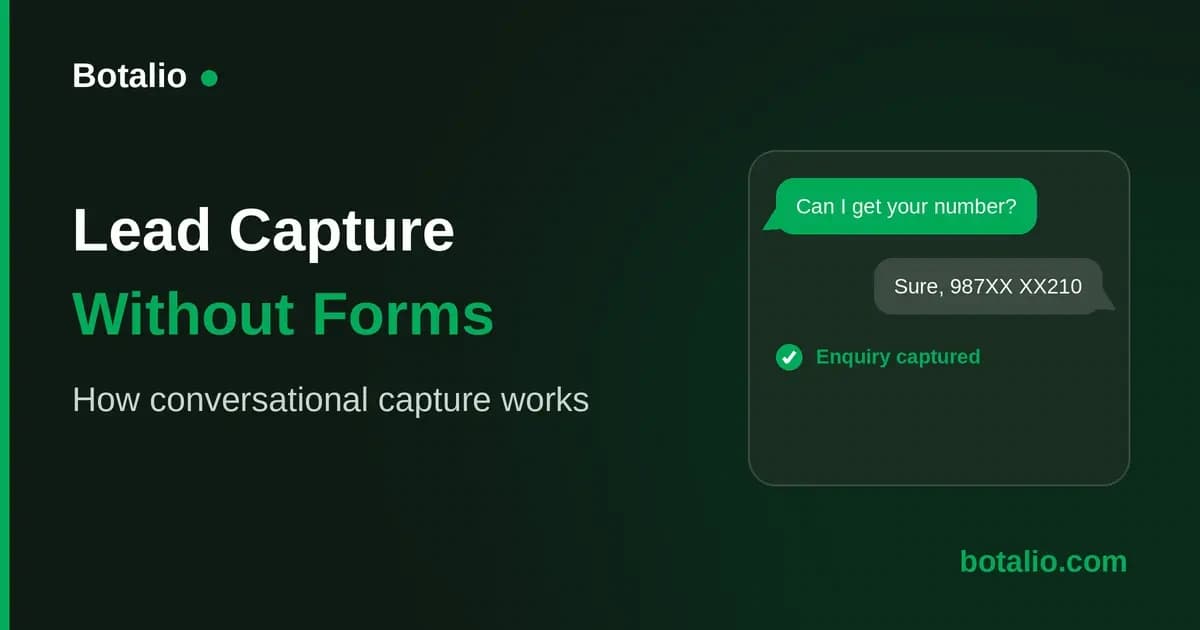
Lead Capture Without Forms: How Conversational Capture Works
Look at your website's contact form honestly for a moment. It gets a trickle of submissions compared to the number of people who visit, and you have probably made peace with that as just how websites work. It is not. That gap between visitors and form submissions is not a law of nature. It is the form itself quietly turning interested people away.
There is a better way to turn a website visitor into an enquiry, and it does not involve a form at all. It is called conversational capture, and it collects a visitor's name and number naturally, inside a conversation, at the moment they are actually interested. This guide explains what lead capture without forms means, why it converts far better than a contact form, and how it works in practice.
The short answer
Lead capture without forms means collecting a visitor's details through a conversation instead of a form. A chatbot answers the visitor's question first, then naturally asks for their name and number so you can follow up. Because it gives value before asking for anything, far more visitors share their details than would ever fill a form.
Why contact forms lose most of your leads
A contact form has a design problem baked into it: it asks the visitor to do work now, for a reward later. Fill in your name, your email, your phone number, type out your question, submit, and then wait, maybe until tomorrow, for a reply. That is a lot to ask of someone who arrived with a quick question and a short attention span.
So most visitors do the rational thing and skip it. They had one small question, the form felt like effort, and the payoff (a callback at some unknown time) was uncertain. They leave without ever telling you they were there. The form did not capture a lead. It filtered one out. This is why we have written before that the contact form is often where website leads quietly go to die.
The people who do fill your form are usually the most motivated few, the ones who were going to contact you anyway. Everyone in the large middle, interested but not yet committed, slips through. Those are exactly the leads a business most needs to catch, and a form is the worst tool for catching them.
What conversational capture actually means
Conversational capture flips the order of the exchange. Instead of demanding information before giving anything, it helps first and asks second.
Here is how it plays out. A visitor lands on your site with a question, say about your pricing or availability. A chatbot answers it instantly and accurately, from your own business content. Now the visitor has received something useful, and trust is higher. At that natural point in the conversation, the chatbot says something like, "I can have our team send you the full details, what is the best number to reach you on?" And because the visitor is already engaged and has already got value, they share it.
The detail gets captured as a byproduct of a genuinely helpful conversation, not as a toll gate before it. That single change, value first, ask second, is why conversational capture converts so many more visitors than a form ever could.
Why it converts better than a form
Three things make conversational capture outperform a static form.
It removes friction. There are no fields to stare at, no "required" errors, no submit button. The visitor just talks, the way they would on WhatsApp, and the details come out naturally in the flow.
It gives value before asking. The visitor gets their question answered first, so by the time you ask for a number, you have earned it. A form asks for everything upfront and offers nothing in return until later.
It catches the hesitant middle. The motivated few will contact you either way. Conversational capture wins you the much larger group who were interested but would never have filled a form, which is where the real growth is.
The result is simple: for the same website traffic, you capture materially more enquiries. Nothing about your traffic changed. You just stopped losing people at the form.
What it captures, and how
A good conversational capture setup collects the same details a form would, name, phone number, and email, but gathers them inside the chat rather than in fields. It picks them up as the visitor mentions them, or asks for them politely at the right moment. It also captures something a form never does: the actual question the visitor asked, so when you follow up, you already know what they care about.
The moment a detail is captured, you get an instant email alert, with the visitor's name, number, and their question, so you can follow up while their interest is still warm. (That instant-alert piece is important enough that we covered it separately in why a website chatbot beats WhatsApp auto-reply for capturing leads.)
A quick before and after
Before: a visitor arrives at 9 pm, wants to know if you are open on Sunday, sees only a contact form, decides it is not worth filling for a one-line question, and leaves. You never know they existed.
After: the same visitor arrives, asks the chatbot "are you open on Sunday," gets an instant "yes, 10 am to 2 pm, would you like us to hold a slot for you? What is a good number to reach you on?" and leaves their number. Next morning you call a warm lead who already told you what they wanted. Same visitor, same question. One version captured the enquiry; the other lost it at the form.
How to set it up on your website
You do not need to build anything or replace your website. The practical way to add conversational capture is an AI chatbot trained on your own business content. You give it your information once, your services, prices, timings, policies, and it answers visitor questions instantly and captures the visitor's details inside the conversation, around the clock.
This is exactly what Botalio does. It sits on your website as a simple chat widget, answers questions from your own content, and captures each visitor's name and number naturally in the conversation, no form required. It then alerts you the moment a lead comes in. Setup is one line of code, it works on WordPress, Wix, Shopify or any custom site, and it needs no developer. A tool that does all of this costs a small business a few thousand rupees a month, not the lakhs quoted for custom builds, as we broke down in our guide on how much an AI chatbot costs in India. You can see the plans on the pricing page.
Frequently asked questions
What is lead capture without forms?
It means collecting a website visitor's details through a conversation instead of a contact form. A chatbot answers the visitor's question, then naturally asks for their name and number to follow up. Because it gives value before asking, far more visitors share their details than would ever complete a form.
Why do contact forms capture so few leads?
Because a form asks the visitor to do work now for a reply later, which most people with a quick question will not do. Only the most motivated few fill it in. The large group of interested but hesitant visitors, the ones you most want to catch, simply leave without submitting anything.
How does a chatbot capture leads without a form?
It answers the visitor's question first, then asks for their name and number at a natural point in the conversation, or picks up the details as the visitor mentions them. The information is collected inside the chat, along with the question they asked, and sent to you as an enquiry.
Is conversational capture better than a contact form?
For most small businesses, yes. It removes friction, gives value before asking for anything, and captures the hesitant middle group that forms lose. For the same website traffic, you typically capture more enquiries, because you stop losing interested visitors at the form.
What details can it capture?
The same as a form, name, phone number and email, plus the actual question the visitor asked, which a form does not record. Capturing the question means that when you follow up, you already know what the visitor cares about, so the conversation starts warm.
How much does conversational lead capture cost in India?
For a small business, roughly Rs. 1,999 to Rs. 3,999 a month depending on volume, not the lakhs charged for custom builds. Botalio itself is free while the product is early, with no paid plan and no card required. Set against the extra enquiries you capture, it usually pays for itself quickly.
Is it hard to set up?
No. You add a single line of code to your website and give the chatbot your business information once. It works on WordPress, Wix, Shopify or any custom site, needs no developer, and is usually live in minutes. If you can copy and paste, you can set it up.
The bottom line
Your contact form is not neutral. Every day it quietly turns away interested visitors who were not willing to do its work for an uncertain reward. The gap between your traffic and your enquiries is largely the form's doing, and it is fixable without touching your traffic at all.
Conversational capture closes that gap by helping first and asking second, so far more visitors become enquiries you can follow up on. That is what an AI chatbot with conversational lead capture does, trained on your own content, live in minutes, no developer needed. Reply with your website link and we will build you a free demo on your own content, so you can watch it answer and capture a visitor before you decide anything.