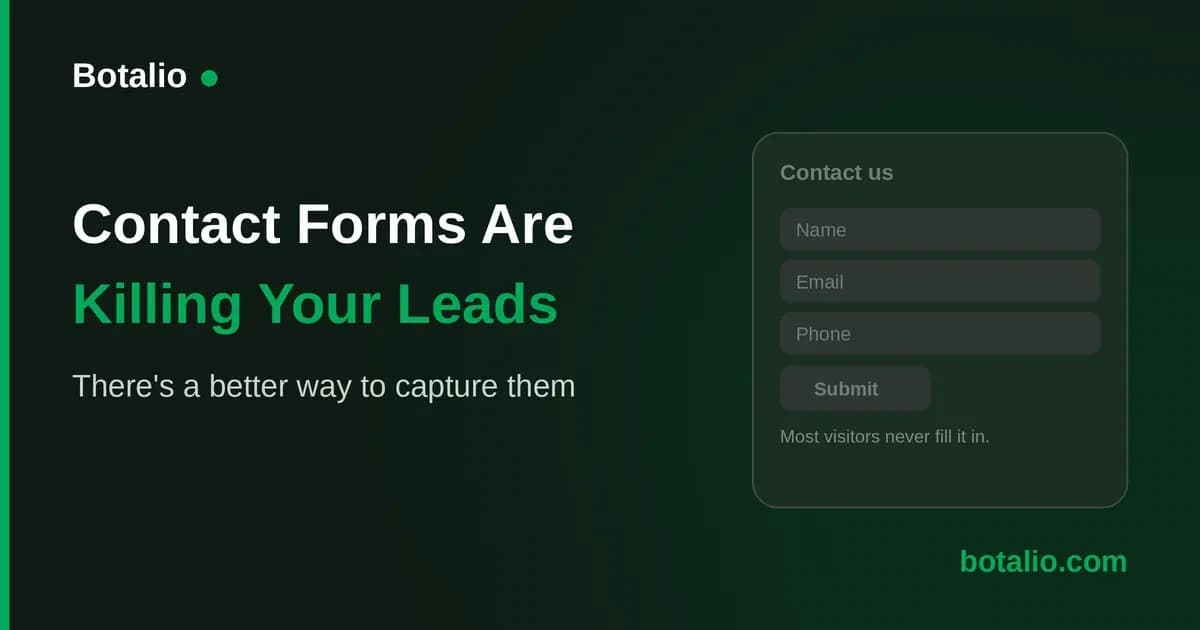
Contact Forms Are Killing Your Leads: What Works Better
Here is an uncomfortable truth about the "Contact Us" form sitting on your website: it is probably losing you more leads than it captures. It looks harmless, even helpful. But quietly, every day, it turns away interested visitors who would happily have become enquiries if you had made it easier. The gap between how many people visit your site and how few fill that form is not bad luck. It is the form doing exactly what forms do.
This is not an argument that contact forms are evil, or that you must rip yours out today. It is an honest look at why they lose so many leads, what a better contact form alternative looks like, and how to capture the visitors your form is currently letting slip away.
The short answer
Contact forms lose leads because they ask the visitor to do work now for a reply later, which most people with a quick question will not do. What works better is answering the visitor instantly and capturing their details inside a conversation, so getting in touch feels like a chat rather than a chore. That captures far more of your interested visitors.
Why contact forms quietly kill leads
A contact form has a flaw built into its very design. It asks the visitor to give first and get later. Fill in your name, your email, your phone number, type out your question, hit submit, and then wait, maybe until tomorrow, maybe longer, for a reply that may never come. That is a genuinely bad deal for someone who arrived with a simple question and thirty seconds of patience.
So most visitors do the sensible thing and skip it. Consider what actually goes through a visitor's head. They had one small question. The form looks like effort. The reward is uncertain and delayed. The next result on Google is one tap away. Multiply that by every visitor, and you can see why a form only ever catches the small handful of people who were highly motivated already, the ones who would have contacted you anyway.
There are four specific reasons forms leak leads:
- They demand effort upfront. Several fields to fill before the visitor gets anything at all.
- They delay the payoff. The answer comes later, if it comes, which kills the momentum of interest.
- They feel like a dead end. The visitor submits into a void with no idea if or when anyone will respond.
- They ignore the quick question. Most visitors do not want a callback; they want one fast answer, and a form cannot give it.
The proof is in your own numbers
You do not need a study to see this. Look at your own website. Compare the number of visitors you get in a month to the number of contact form submissions. For most small business sites, form submissions are a tiny fraction of traffic, often well under two percent. That is not because the other ninety-eight percent were uninterested. Many of them had a real question. The form simply was not worth the effort to ask it, so they left, and you never knew they were there.
That silent majority is exactly the group worth capturing, and it is the group a form is worst at reaching.
What works better than a contact form
The fix is not a better-designed form. It is a different approach to getting in touch, one that flips the order: give value first, ask second. Here is what actually captures more of your visitors.
Answer the question instantly. The single biggest improvement is responding to the visitor's question in the moment, rather than promising a reply later. An answer now keeps them on your site and interested. This is where an AI chatbot shines, it answers from your own business content the second the visitor asks.
Capture details inside a conversation, not in fields. Instead of a wall of inputs, the visitor's name and number come out naturally in the flow of a chat, after they have already got value. We explained exactly how this works in our guide on lead capture without forms, and it is the core reason conversational capture outperforms a form.
Make getting in touch feel like WhatsApp, not paperwork. People are comfortable typing a quick message. They are not comfortable filling forms. A chat interface feels familiar and low-effort, which is why more visitors engage with it.
Follow up instantly. Even the leads a form does capture often go cold because the reply is slow. An instant email alert the moment a lead comes in lets you respond while interest is still warm. We covered that in how to get website leads sent to WhatsApp instantly.
Ask for less, later. A form demands everything upfront. A good conversation asks for a number only once the visitor is engaged and has a reason to share it, which dramatically raises the number who do.
Put together, these add up to one thing: an AI chatbot that answers instantly and captures the lead in conversation. It is the most complete contact form alternative because it fixes every reason a form fails at once.
Do contact forms ever make sense?
To be fair, yes, sometimes. A contact form is fine for genuinely non-urgent, detailed submissions, a job application, a long partnership enquiry, a detailed quote request where the person expects to write a paragraph and wait. In those cases the visitor is already committed and the delay is expected.
The point is not that forms are always wrong. It is that using a form as your main way to capture everyday website enquiries, the quick "what's the fee," "are you open Sunday," "do you have a 3BHK" questions, loses most of them. For those, which are the majority of what a small business website gets, a conversation wins every time. Keep a form if you like; just do not rely on it to catch the leads it was never good at catching.
Frequently asked questions
Why do contact forms lose so many leads?
Because a form asks the visitor to do work now for a reply later, which most people with a quick question will not do. Only the most motivated few fill it in. The large group of interested but casual visitors, who just want a fast answer, leave without submitting anything.
What is a good contact form alternative?
The best alternative is an AI chatbot that answers the visitor's question instantly and captures their name and number naturally inside the conversation. It gives value before asking for anything, feels like a chat rather than paperwork, and captures far more of your interested visitors than a form.
Should I remove my contact form entirely?
Not necessarily. A form still suits genuinely detailed, non-urgent submissions like job applications or long quote requests. The mistake is relying on it to capture everyday quick enquiries, which it loses. You can keep a form and add a conversational option that catches the visitors the form misses.
What captures more leads than a form?
A conversation does. Answering the visitor instantly, letting them ask in a familiar chat interface, collecting their details in the flow, and alerting you the instant a lead comes in all capture more leads than a static form, because they remove the effort and delay that make visitors abandon forms.
How much does it cost to replace a form with a chatbot in India?
For a small business, roughly Rs. 1,999 to Rs. 3,999 a month depending on volume, not the lakhs charged for custom builds. Botalio itself is free while the product is early, with no paid plan and no card required. We break the full picture down in our guide on how much an AI chatbot costs in India.
Do contact forms ever make sense?
Yes, for detailed, non-urgent submissions where the visitor expects to write at length and wait, such as applications or complex quote requests. They fail when used as the main way to capture everyday quick enquiries, which are the majority of small business website traffic and are far better handled by a conversation.
Will a chatbot annoy my visitors?
A well-built one does the opposite. Instead of a silent form, it answers the visitor's actual question in seconds, which most people find genuinely helpful. The key is that it helps first and asks for details second, so it feels like useful service, not an interruption.
The bottom line
Your contact form is not neutral. Every day it turns away interested visitors who were not willing to do its work for an uncertain, delayed reward, and you never even see the ones it loses. The gap between your traffic and your enquiries is largely the form's doing.
The fix is to stop making getting in touch feel like paperwork. Answer instantly, capture the lead in a conversation, and follow up fast. That is what an AI chatbot does, and it is the contact form alternative that catches the visitors your form is currently letting go. If you want to see it on your own site, reply with your website link and we will build a free demo trained on your own content, so you can watch it answer and capture a visitor before you decide anything. You can also see what is included on the pricing page.