Best AI Chatbot for D2C and Shopify Brands in India (2026)
If you run a D2C brand in India, you already know the shape of the problem. The ads work. Traffic looks healthy. And then the store converts at somewhere between one and two percent, and nobody can tell you what happened to the other ninety eight.
Some of it is price. Some of it is trust. But a large, quiet slice of it is a question that never got answered. Will this ship to Coimbatore before Friday? Is this the right size if I usually wear a medium? Can I return it if it does not fit? Those questions arrive at eleven at night, on a phone, from someone who is one tap away from a competitor's Instagram ad.
A chatbot for a D2C brand in India is not a support tool. It is a conversion tool. That distinction decides which product you should buy and what you should pay for it. This guide covers what these bots do for an Indian store, what they cost in rupees, and how to set one up on Shopify or WooCommerce.
What is the best AI chatbot for a D2C brand in India?
The best chatbot for an Indian D2C brand is an AI chatbot trained on your own product catalogue, shipping policy and returns policy, priced in rupees, that answers pre purchase questions instantly and captures the shopper's name and number when they do not buy. Rule based menu bots and per agent live chat tools solve a different problem.
That is the short version. The rest of this guide is why, and how to tell the categories apart when every product page claims to be AI.
Where D2C brands actually lose orders
There are three moments in an Indian D2C funnel where a shopper goes quiet, and only one of them is the one most brands optimise for.
The pre purchase doubt. Someone is on a product page at 11:40 pm. They like the item. They have one blocking question, usually a small one: fit, fabric, wash care, whether the shade matches the photo. There is no one to ask, and the FAQ page is three clicks away and written in generic language. They close the tab and tell themselves they will come back. Almost nobody comes back.
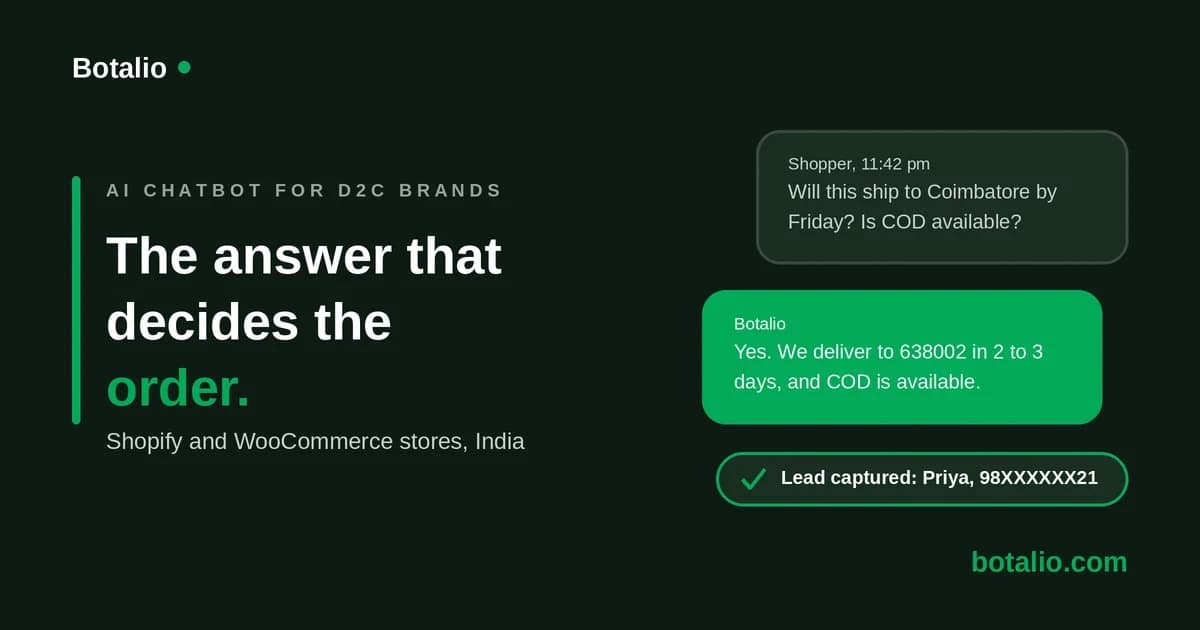
The delivery and payment doubt. This one is specific to India and it is enormous. Will it reach my pin code? How many days? Is COD available at 638002? Is the return pickup free or does it come out of my refund? For a first time buyer of an unfamiliar brand, these are the entire purchase decision. A store that answers them in three seconds converts a shopper that a store with a policy page does not.
The post order anxiety, better known as WISMO. Where is my order. This is the highest volume message any Indian D2C brand receives. It does not directly cost you a sale, but it eats the hours you should be spending on the first two moments.
Most brands respond to all of this with a contact form and a support email address. We have written before about why contact forms leak leads, and the D2C version is the harshest one: a form asks a shopper who is ready to buy right now to instead do work and wait for a reply tomorrow. By tomorrow the intent is gone.
The seven jobs a D2C chatbot has to do
If a tool cannot do most of these, it is not a D2C chatbot, whatever the pricing page says.
- Answer product questions from your actual catalogue. Fabric, fit, ingredients, dimensions, care, compatibility. Not a generic AI guess. If it invents a fabric composition, you will spend more time on returns than you saved on support.
- Answer shipping and delivery questions by pin code logic. Serviceability, timelines, COD availability, shipping charges, free shipping thresholds. This is the highest intent question on any Indian store.
- Answer returns, exchange and refund policy in plain language. Shoppers do not read policy pages. They ask.
- Handle size and variant guidance. A size chart is a table. A shopper asks "I am 5 foot 6 and 62 kilos, what size?" A chatbot that reads your size chart can answer that. A table cannot.
- Capture the name, phone number and email of shoppers who do not buy. This is the job that pays for the tool. A visitor who asks a question and leaves is a warm lead with stated intent. If your bot does not collect contact details, you are running a support desk, not a conversion tool.
- Alert you the moment a high intent conversation happens. An alert carrying the shopper's number and exactly what they asked is worth more than a dashboard you check on Sunday. The same website leads to WhatsApp flow that works for service businesses works here, and for D2C it means your team can follow up on an abandoned high value cart within the hour.
- Work in the languages your customers actually type in. A meaningful share of Indian shoppers will type in Hindi, Tamil, Telugu, Marathi or Hinglish, especially outside metros. A bot that only handles clean English quietly loses those conversations.
The four kinds of chatbot Indian D2C brands get sold
Every one of these calls itself a chatbot. They are not the same product and they do not have the same price.
| Type | What it actually is | Answers your product questions | Captures leads | Typical India cost |
|---|---|---|---|---|
| Rule based menu bot | Buttons and decision trees. Breaks the moment someone types a real sentence | No, only what you scripted | Sometimes, via a form step | Rs. 0 to Rs. 1,500/month |
| Live chat with human agents | A chat window staffed by your team. Good conversations, but only during working hours | Only when a human is online | Yes, if someone replies | Rs. 1,000 to Rs. 3,000 per agent/month |
| WhatsApp automation tool | Broadcasts, abandoned cart flows and order updates on WhatsApp. Excellent, but it starts after the shopper has already messaged you | Limited | Only existing contacts | Rs. 2,000 to Rs. 6,000/month plus Meta per message fees |
| AI chatbot trained on your store | Reads your catalogue and policies, answers real typed questions any hour, collects the shopper's details | Yes | Yes, inside the conversation | Rs. 0 to Rs. 8,000/month |
The two categories brands most often confuse are the last two. WhatsApp automation is genuinely good at what it does, and if you are running abandoned cart recovery on WhatsApp you should keep doing it. But it can only reach someone who has already given you their number. The shopper on your product page at 11:40 pm has not. That is the gap a website chatbot fills, and the two work well together: the website bot catches the stranger and hands the number to your WhatsApp flows.
What a chatbot for a D2C brand costs in India
Here are real 2026 rupee figures, because most pages that rank for this question are written by development agencies quoting custom builds.
A ready made SaaS chatbot for an Indian D2C store runs from Rs. 0 to about Rs. 8,000 per month. A free plan gets you a small conversation cap and a badge, which is enough to test whether it answers your customers' actual questions. A single store with real traffic sits comfortably at Rs. 1,999 to Rs. 3,999 per month. Multiple stores or a brand running several catalogues lands closer to Rs. 7,999.
What moves the number: monthly conversation volume, how many separate chatbots you need, whether AI is included or sold as a paid upgrade on top of a cheap base plan, and whether you are billed in rupees or dollars. That last one matters more than founders expect, because a 39 dollar plan is over Rs. 3,200 before forex charges and it moves with the exchange rate. We covered the full breakdown, including the traps, in our guide to how much an AI chatbot costs in India.
For reference, Botalio is free while the product is early: no paid plan, no card, AI included, and no per-agent fees. Most honest Indian SaaS chatbots price somewhere in the range above, so treat those figures as your benchmark when comparing tools.
What you should not pay: lakhs. A custom built chatbot costs Rs. 50,000 to Rs. 8 lakh upfront and Rs. 15,000 to Rs. 75,000 a month to run. That is the right answer for a bank. It is the wrong answer for a skincare brand doing 400 orders a month.
How to set one up on Shopify or WooCommerce
This takes an afternoon, not a sprint. The steps are the same on either platform.
- Gather what the bot needs to read. Your product catalogue, shipping policy, returns policy, size chart, and your ten most repeated customer questions. If you have a WhatsApp support inbox, scroll it for twenty minutes. Those are your real FAQs, not the ones on your FAQ page.
- Upload it and set the bot's role. A good tool lets you upload documents or point it at your site rather than making you script conversations. This is the step that decides answer quality, so do not rush it.
- Paste the embed code. On Shopify, add the script to your theme through Online Store, then Themes, then Edit code, dropping it before the closing body tag in theme.liquid. On WooCommerce, use a header and footer script plugin or your theme's custom scripts field. One line, no developer.
- Set your lead alerts. Set the alert email to whoever actually follows up, not a shared inbox nobody checks. Add a webhook if you also want the lead's name and number forwarded into an automation tool for WhatsApp. An alert nobody sees is not an alert.
- Test it like a suspicious customer. Ask it the awkward questions. Ask about a product you discontinued. Ask in Hinglish. Ask if it ships to a pin code you do not serve. You are looking for confident wrong answers, which are the only genuinely dangerous failure mode.
- Check it after a week and fix the gaps. Read the transcripts. Every question the bot fumbled is a document you have not uploaded yet.
Five mistakes we keep seeing
Treating it as support instead of sales. If the bot's only job is deflecting WISMO tickets, it pays for itself in hours saved and nothing else. The revenue is in the pre purchase conversation and in the contact details of shoppers who did not buy.
Letting it guess. A chatbot that invents a return window or a delivery timeline creates a refund dispute and a bad review. Insist on a tool that answers from your uploaded content and says it does not know when it does not know.
Hiding it until the shopper hunts for it. A silent icon in the corner gets ignored on mobile. A small proactive prompt phrased around the real question ("Ask me about sizing, delivery or returns") is the difference between a bot people use and a bot people scroll past.
Ignoring the transcripts. Chat logs are the cheapest customer research you will ever get, and they tell you which product page is unclear and which policy is scaring people off, in your customers' own words.
Buying on the base price. The cheap plan that charges extra to switch on AI, or per agent, or per conversation over your cap, is usually the expensive one by month three.
Frequently asked questions
How much does a chatbot for a D2C brand in India cost?
A ready made SaaS chatbot costs between Rs. 0 and roughly Rs. 8,000 per month in India. Most single store D2C brands settle between Rs. 1,999 and Rs. 3,999 a month. Custom built chatbots cost Rs. 50,000 to Rs. 8 lakh upfront, which almost no D2C brand needs.
Can I add an AI chatbot to Shopify without a developer?
Yes. A SaaS chatbot gives you one line of embed code that you paste into your Shopify theme under Online Store, Themes, Edit code, just before the closing body tag in theme.liquid. It takes a few minutes and needs no coding knowledge or paid app development.
Does a chatbot work with WooCommerce and custom stores too?
Yes. The same single line of code works on WooCommerce, WordPress, Wix, Squarespace, Webflow and custom built stores. On WordPress you can paste it using any header and footer script plugin. Nothing about the setup is specific to one ecommerce platform.
Will an AI chatbot give customers wrong product information?
It can, if it is not trained on your content. A chatbot that answers only from your uploaded catalogue and policy documents, and admits when it does not know, is safe. Always test it with awkward questions before going live, including products you have discontinued.
Is a website chatbot better than WhatsApp automation for D2C?
They do different jobs. WhatsApp automation reaches people who already gave you their number, which is excellent for abandoned cart and order updates. A website chatbot catches the stranger browsing at midnight who has not messaged you yet, and hands you their number. Most brands benefit from both.
Can the chatbot handle Hindi and other Indian languages?
Good AI chatbots do. A meaningful share of Indian shoppers type in Hindi, Tamil, Telugu, Marathi or Hinglish, especially outside metro cities. Check that the tool supports Indian languages properly rather than only clean English, because those conversations are usually lost silently.
Will a chatbot actually increase my conversion rate?
It helps most where doubt blocks a purchase: sizing, fabric, delivery timelines, COD availability and returns. Answering those in seconds keeps a shopper on the page instead of on a competitor's. The bigger measurable gain for most brands is the contact details captured from shoppers who did not buy.
How long does it take to go live?
Under an hour of actual work for most stores. Uploading your catalogue, policies and size chart is the slow part, and that is thirty minutes if the documents already exist. Pasting the embed code takes minutes. Refining answers from real transcripts happens over the first week.
Where to start
If you take one thing from this guide, take the reframe: for a D2C brand, a chatbot is not a cheaper support agent. It is the thing standing between a shopper's small blocking question and a competitor's Instagram ad. Answer the question in three seconds and you keep the order. Answer it tomorrow by email and you were never in the running.
Start by picking the ten questions your customers ask most, and check whether your website answers any of them without a human. If it does not, that is your gap, and it is a cheap one to close.
If you want to see it working on your own store first, we will build you a free Botalio demo trained on your actual product catalogue and policies, no card and no commitment, and you can ask it the questions your customers ask you every day. Have a look at the AI chatbot for D2C brands page for what it looks like on a store like yours, or start free on the pricing page.