Best AI Chatbot for CA Firms and Law Firms in India (2026)
Professional practices have a problem that most software ignores. You are not trying to sell something to everyone who visits your website. You are trying to work out, quickly and without wasting a partner's afternoon, which enquiries are worth a consultation and which are someone hoping for free advice.
A chatbot for a CA firm in India, or for a law practice, has to be built around that distinction. Most are not. They are retail sales bots wearing a suit, designed to push everyone toward a booking, and in a regulated profession that is worse than useless. It creates compliance exposure, wastes your time, and makes the firm look like it is chasing work.
This guide covers what a chatbot should and should not do for a professional practice, the Bar Council and ICAI constraints that actually apply, what to look for, what it costs in rupees, and how to set one up without stepping on any of it.
What is the best AI chatbot for a CA or law firm in India?
The best chatbot for an Indian CA or law firm answers procedural and administrative questions from your own content, refuses to give case-specific tax or legal advice, and collects enquiry details for a qualified human to review. It should reduce the reception load and filter enquiries, not sell consultations or imply an engagement.
The advertising rules you cannot ignore
This is the part every generic chatbot guide skips, and it is the part that matters most for your practice.
For advocates, the Bar Council of India's rules restrict advertising and solicitation of work. A website that provides factual information about the firm, its people and its practice areas is generally accepted; language that solicits clients, promises outcomes, or reads as touting is not. A chatbot is website content. Anything it says is something your firm published.
For chartered accountants, the ICAI Code of Ethics similarly restricts solicitation and advertising, with guidance on what a member's website may contain. The direction of travel in recent years has loosened somewhat, but the core principle holds: informational, yes; soliciting, no.
We are not your compliance advisers and this is not legal advice, so confirm the current position with your own Bar Council or ICAI guidance before publishing anything. But the practical consequence is simple and worth stating plainly: a chatbot configured with sales language is a liability for a professional practice, not an asset. Every "Book now and get your first consultation free" style prompt that a retail chatbot ships with by default is exactly the wrong thing on your site.
What you want instead is a bot that behaves like a well-briefed receptionist. Answers what the firm does, who does it, where you are, how the process works, what documents are typically needed. Takes a message. Does not pitch, does not promise, does not advise.
The three things it should never do
- Give case-specific advice. "Can I claim HRA and a home loan deduction together in my situation?" has no safe automated answer, because the answer depends on facts the bot does not have. It should say so and offer to take the enquiry.
- Imply an engagement exists. A visitor should never come away thinking the firm has taken their matter on, or that they have received an opinion they can rely on.
- Promise an outcome. No estimated refunds, no likelihood of success, no timelines it cannot guarantee.
A bot that confidently invents an answer to a tax question is the single biggest risk in this vertical. Test for it specifically before going live, using questions you know are fact-dependent, and confirm it declines rather than guesses.
What it should actually handle
The good news is that the questions eating your reception's day are almost entirely safe to automate.
| Question type | Example | Safe to automate |
|---|---|---|
| Services offered | Do you handle GST registration? Do you do property matters? | Yes |
| Process and timelines | What happens after I engage you? How long does an ITR filing usually take? | Yes, in general terms |
| Documents required | What do I need to bring for a company incorporation? | Yes |
| Fee structure | Do you charge a fixed fee or hourly? | Yes, as a general policy or range |
| Location and availability | Where are you? Do you meet on Saturdays? | Yes |
| Consultation booking | I would like to speak to someone about a partnership dispute | Yes, as a message and callback |
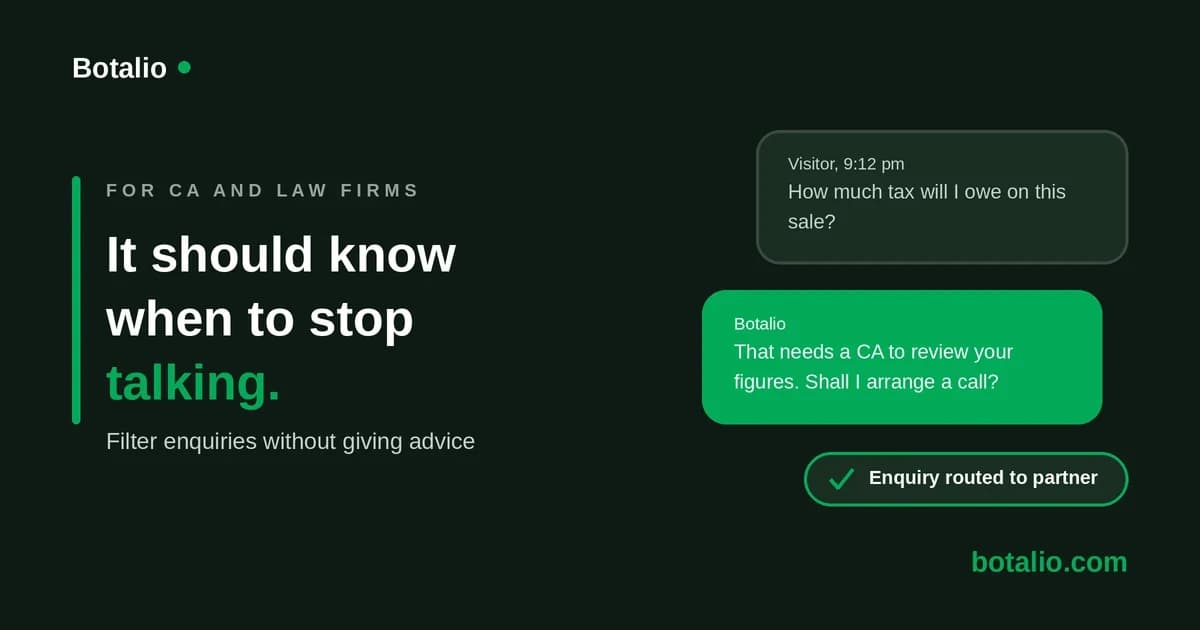
| Case-specific advice | Will I win this case? How much tax will I owe? | No, decline and route to a person |
The pattern is clear: everything administrative and procedural is fair game. Everything requiring judgement about a specific person's facts is not.
Why filtering matters more than capturing
Most chatbot marketing is built around volume. For a professional practice, volume is the problem.
A partner's hour is the scarce resource. An enquiry that turns out to be a student asking about articleship, a person wanting free advice on a matter they will never engage anyone for, or a service you do not offer, costs you real money in wasted attention. Firms we speak to consistently say the issue is not too few enquiries, it is that the useful ones are buried among the ones that were never going to go anywhere.
So the job is qualification, not capture. A chatbot that asks two or three sensible questions before taking a message, such as the broad nature of the matter, roughly when they need help, and whether they have engaged anyone previously, hands your team a queue they can triage in minutes instead of a pile of one-line messages saying "need help with tax."
This is a different design goal from the one behind a retail chatbot, and it is worth checking that whichever tool you choose can actually be configured this way. The general principle here is the same one we wrote about in lead capture without forms, because a conversation gathers better information than a form, since it can ask the follow-up question a form cannot.
Confidentiality and data
Professional practices carry duties that most website software was not designed around.
Assume the chatbot is not a confidential channel, and say so. A visitor should not be typing sensitive case facts into a website widget. A short line stating that the chat is for general enquiries and not for confidential information does a lot of work here, and a well-configured bot should also steer people away from volunteering detail it does not need.
Know where the data goes. Under the Digital Personal Data Protection Act, you are responsible for personal data you collect. Ask any vendor where conversations are stored, how long they are retained, whether the data is used to train models, and whether you can delete it on request. A tool that stores data in India makes this conversation considerably shorter.
Limit what you collect. For an initial enquiry you need a name, a contact number, and a broad category of matter. You do not need the details, and asking for them creates risk without adding value.
What it costs
A ready-made chatbot for a CA or law firm in India runs from Rs. 0 to roughly Rs. 8,000 per month. A single-office practice with one website sits comfortably at Rs. 1,999 to Rs. 3,999. A multi-branch firm or one running separate sites for different practice areas lands nearer Rs. 7,999.
Botalio is free while the product is early. There is no paid plan and no card required. Every account gets 500 conversations a month, 2 chatbots, and 5 knowledge base documents per chatbot.
Put that against the arithmetic that actually matters in a professional practice: partner and senior staff time. If automating routine enquiry handling saves a few hours a month of qualified time, the subscription has paid for itself before you count a single new engagement. This is the reasoning we built Botalio around for Indian professional firms, and you can see what is included on the pricing page.
What you should not pay is lakhs for a custom build. Those quotes exist, they start around Rs. 50,000 and climb steeply, and they solve a problem a practice of your size does not have. Our fuller breakdown of the numbers is in how much an AI chatbot costs in India.
Setting it up properly
- Write your scope boundary first, before anything else. One short paragraph stating what the bot may answer and what it must decline. This is the document everything else follows from.
- Gather the safe content. Practice areas, process explanations, document checklists, office details, fee policy in general terms, your people and their qualifications.
- Have someone senior review the answers as published content. Because that is what they are. If a partner would not put it in a firm brochure, it should not be in the bot.
- Configure the decline behaviour explicitly. Test with fact-dependent questions and confirm it routes to a human rather than attempting an answer.
- Add the confidentiality line where visitors will see it before they type.
- Point alerts at whoever actually triages enquiries, and read the first two weeks of transcripts properly. They will show you which practice-area page on your site is unclear.
Frequently asked questions
How much does a chatbot for a CA or law firm cost in India?
A ready-made SaaS chatbot costs Rs. 0 to about Rs. 8,000 per month, with most single-office practices paying Rs. 1,999 to Rs. 3,999. Custom-built chatbots start around Rs. 50,000 upfront and run far higher, which no small or mid-sized professional practice needs. Botalio is free while the product is early, with no paid plan and no card required.
Is a website chatbot allowed under Bar Council or ICAI rules?
Informational website content is generally accepted, while solicitation and advertising are restricted. A chatbot is published website content, so the same rules apply to whatever it says. Configure it to inform rather than sell, and confirm the current position with your own professional body.
Can the chatbot give tax or legal advice?
It should not, and this is the most important configuration decision you will make. Case-specific questions depend on facts the bot does not have. It should decline clearly, avoid implying an engagement exists, and route the enquiry to a qualified person instead.
What if the chatbot gives a wrong answer?
That is the main risk, and it is managed by scope rather than hope. Restrict it to your own uploaded content, configure it to decline anything fact-dependent, and test with deliberately tricky questions before launch. A bot that says it does not know is working correctly.
Is client information typed into the chat confidential?
Treat it as not confidential and tell visitors so. A website widget is not a privileged channel, and people should not be entering case details into one. Ask your vendor where data is stored and how long it is retained, since DPDP obligations sit with your firm.
Will it replace our receptionist or junior staff?
No. It handles the repetitive administrative questions that arrive outside office hours, and it filters enquiries before they reach anyone senior. Your people keep the work that actually needs judgement: the consultation itself, the triage decision about whether a matter is worth taking, and the client relationship.
How is this different from a chatbot for a retail business?
The goal is inverted. A retail chatbot maximises conversions and pushes everyone toward a purchase. A professional practice chatbot filters, declines what it should not answer, and protects senior time. Most tools ship configured for the first job, so check yours can be set up for the second.
How long does it take to set up?
A few hours of real work, with most of that spent agreeing the scope boundary and reviewing answers rather than on anything technical. Adding it to your website is one line of code. Budget a partner review before it goes live, because it is published firm content.
Where to start
The test for whether a chatbot belongs on a professional practice's website is not whether it can hold a conversation. It is whether you would be comfortable with a partner reading every word it has said this month.
Write your scope boundary, restrict it to content you have already published elsewhere, configure it to decline anything fact-specific, and it becomes what a practice actually needs: a receptionist who works at midnight, answers the same twelve procedural questions without complaint, and knows precisely when to stop talking and take a message.
If you want to see how that behaves on your own site, we will build you a free demo trained on your firm's actual content, no card and no commitment, and you can try the awkward questions yourself. The AI chatbot for CA and law firms page shows what it looks like for a practice like yours.