24/7 Admission Enquiry Capture for Coaching Centres (2026)
Every coaching centre owner we speak to describes the same week. Admission season opens, the website traffic doubles, the counsellors are on calls all day, and at the end of the month the enquiry register has forty names in it while the analytics dashboard says four thousand people visited.
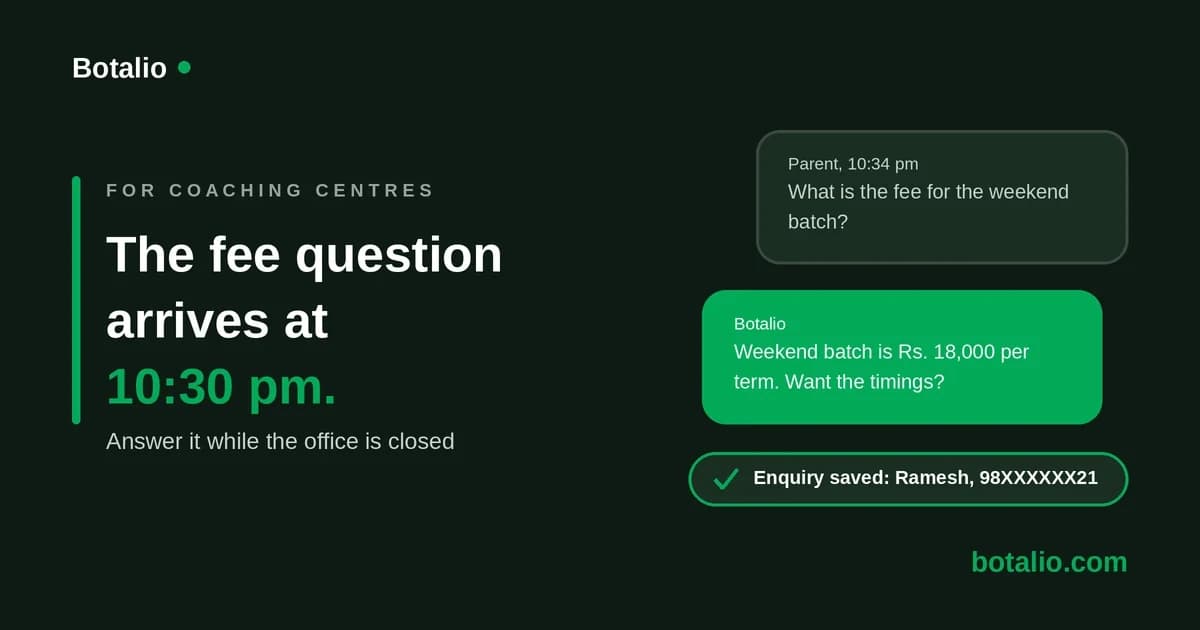
The gap is not a traffic problem. It is a timing problem. 24/7 admission enquiry capture matters for coaching centres because the parent researching your institute is doing it at 10:30 pm after the children have eaten, on a Sunday afternoon, or during a lunch break, and your counsellor desk is empty at all three of those moments.
This guide covers when enquiries actually arrive, what parents actually ask, the four ways centres try to handle it and what each one really achieves, and how to have something in place before the next intake rather than after it.
How do you capture admission enquiries 24/7?
Put something on your website that answers fee, batch, timing and syllabus questions instantly at any hour, collects the parent's name and phone number inside that conversation, and alerts your counsellor immediately. An AI chatbot trained on your own brochure does this without staffing the desk overnight.
When admission enquiries actually arrive
Look at your own analytics before you take our word for it, but the pattern is consistent across the coaching centres we have worked with.
Daytime traffic is students. Evening traffic is parents, and parents are the ones who decide. That shift usually happens after 8 pm, once dinner is done and the working parent is finally free to look properly. Weekends are the other peak, particularly Sunday afternoons, when families sit down together and compare two or three institutes in one sitting. Neither window has a counsellor in it.
The second thing worth knowing: a parent comparing institutes almost never contacts only one. They have three tabs open from the same search, or three numbers saved from three websites. Whoever answers the fee question first becomes the reference point everyone else is measured against. We covered the research behind this in our piece on speed to lead for small business, and the effect is sharper in admissions because the decision has a deadline attached.
What parents actually ask
If you are going to answer questions automatically, you need to know which ones. From real enquiry conversations, the list is short and it repeats:
- What is the fee for this course? By far the most common, and the one most websites deliberately avoid answering.
- What are the batch timings, and is there a weekend batch? The working-parent question.
- When does the next batch start? Urgency signal. Answer this one fast.
- Do you have online or hybrid classes?
- Who teaches it, and what is their background?
- What were last year's results?
- Is there a demo or trial class? The single highest-intent question a parent can ask.
- Where exactly are you, and is there transport or hostel support?
None of these needs a counsellor. All of them are already answered in your brochure. That is the whole opportunity: eight questions, already documented, currently unavailable at the hour they get asked.
The four ways centres try to handle this
| Approach | Answers at 10 pm | Gets you a phone number | What actually happens |
|---|---|---|---|
| Enquiry form | No | Only if they fill it | Parent wanted a fee, was asked for their details first, left |
| Phone number on the site | No | Only if they call | Rings an empty office, or a personal phone at dinner |
| WhatsApp click-to-chat button | Only if someone is awake | Yes, you get the number | Good, but it depends on a human replying, and unanswered messages read worse than no messages |
| AI chatbot trained on your content | Yes | Yes, inside the conversation | Answers the fee question, then asks for a number so a counsellor can call back |
The WhatsApp button deserves credit, because it is genuinely the best of the three traditional options and most centres should have one. But it moves the problem rather than solving it. A parent who messages at 10:30 pm and sees two blue ticks with no reply until Monday has learned something about your responsiveness, and it is not good.
What "24/7" actually has to include
Being available round the clock is not the same as being useful round the clock. Four things have to be true:
- It answers the real question. A bot that replies "our counsellor will contact you shortly" is a form with extra steps. If it cannot state the fee, it has not helped.
- It collects a phone number. An answered question with no contact detail is a nice gesture that earns you nothing. The number is the asset.
- It alerts a human immediately, with enough to act on. The alert should carry the parent's name, number and the exact question asked, so a counsellor can call back without opening anything else. A webhook lets you push the lead's name and number onward to WhatsApp or SMS yourself, if you want it there too.
- It logs the conversation. Reading what parents actually asked last week is the cheapest market research a centre can do, and it will tell you which course page is unclear and which fee is scaring people off.
Setting it up before the next intake
This is an afternoon, not a project.
- Collect your source material. Fee structure, batch timings, syllabus outline, faculty list, results, demo class policy, address and transport details. Most of this exists in your brochure already.
- Add the eight questions above with your real answers. Write them the way a counsellor would say them on the phone, not the way a prospectus is written.
- Decide your fee-disclosure policy now. Most centres hesitate here. Our honest view: state a range. A parent who cannot find any fee assumes it is unaffordable and leaves. A range filters out the wrong fit and builds trust with the right one.
- Put it live and point alerts at the counsellor who actually calls back. One named person, not a shared inbox.
- Test it as a parent would. Ask awkward questions. Ask about a batch that is full. Ask in Hinglish, because a large share of parents will.
- Read the transcripts after a week and fill the gaps it fumbled.
What this costs
A ready-made chatbot for a coaching centre in India runs between Rs. 0 and roughly Rs. 8,000 a month. A single centre with one website sits comfortably at Rs. 1,999 to Rs. 3,999. Multiple branches or separate course sites land nearer Rs. 7,999.
Botalio is free while the product is early. There is no paid plan and no card required. Every account gets 500 conversations a month, 2 chatbots, and 5 knowledge base documents per chatbot.
Set that against one admission. If your annual course fee is Rs. 40,000, a single extra student recovered from a Sunday night enquiry pays for the entire year of software several times over. This is the arithmetic we built Botalio around, and you can see what is included on the pricing page. For a fuller vertical comparison, we have also written a guide to the best AI chatbot for coaching institutes in India.
What you should not pay is lakhs. Custom-built chatbots start around Rs. 50,000 upfront and go far higher. No coaching centre needs one.
Frequently asked questions
How much does 24/7 admission enquiry capture cost?
A ready-made SaaS chatbot costs Rs. 0 to about Rs. 8,000 per month in India, with most single-branch coaching centres paying Rs. 1,999 to Rs. 3,999. Set against a course fee of Rs. 30,000 or more, a single recovered admission covers the annual cost several times over. Botalio is free while the product is early, with no paid plan and no card required.
Should the chatbot tell parents our fees?
We think yes, at least as a range. Parents who cannot find any fee assume the worst and move on to an institute that was upfront. A stated range filters out enquiries that were never going to convert and builds trust with the ones that will.
Will it work during admission season traffic spikes?
Yes, and that is exactly when it matters most. Software does not get overwhelmed the way a counsellor desk does during peak intake weeks, when every call is competing for the same few people. Check the conversation limit on whichever plan you choose against your expected season traffic before committing.
Do we still need counsellors?
Absolutely. The chatbot handles the eight repeated questions at hours nobody is working and hands over a name and number. Counsellors do the part that actually closes an admission: the call, the campus visit, the reassurance. It removes the repetition, not the people.
What if a parent asks something the bot does not know?
A well-configured bot says it does not know and offers to have someone call back, which is the correct behaviour. A bot that invents a fee or a batch date creates a problem your counsellor has to fix later. Test this specifically before going live.
Can it handle Hindi and regional languages?
Good ones do. A meaningful share of parents will type in Hindi, Tamil, Telugu, Marathi or Hinglish, especially outside metro cities. Confirm the tool handles Indian languages properly rather than only clean English, because those enquiries are otherwise lost silently.
How quickly can we have this running?
Under an hour of real work. Gathering the fee structure, timings and faculty details is the slow part, and it is thirty minutes if the brochure already exists. Adding it to the website is one line of code. Refining answers from actual transcripts happens over the first week.
Before the next batch opens
The enquiries you are losing are not the ones that needed convincing. They are the parents who had a straightforward question at an hour when nobody was there to answer it, and who found an institute that did.
Pick your eight questions, write down your real answers, and make sure something on your website can say them at 10:30 pm on a Sunday. Everything else in admissions is harder than this.
If you want to see it working on your own site first, we will build you a free demo trained on your institute's actual content, no card and no commitment, so you can ask it the questions your counsellors answer forty times a week. The AI chatbot for coaching institutes page shows what it looks like on a centre like yours.