How Agencies White-Label AI Chatbots as a Monthly Service
Your clients are going to buy an AI chatbot in the next twelve months. The only real question is whether they buy it from you or from an ad they saw somewhere. You already built their website, you already manage their marketing, and you already have their trust. A white-label chatbot is one of the few new services an agency can add without hiring anyone, deploy in an afternoon, and bill every month.
This guide covers how that actually works: what white-labelling means in practice, the margin maths at real Indian rupee numbers, how to price and pitch it to clients, and what to look for in a platform. It is written for small and mid-sized Indian agencies, the two to twenty person shops building and managing SMB websites.
The short answer
Agencies white-label AI chatbots by subscribing to one agency-tier platform, deploying a separately trained chatbot on each client's website under the agency's own branding, and billing each client a monthly managed fee. Because the platform cost is flat and per-client billing is not, margin improves with every client added.
What white-labelling actually means
White-labelling means the chatbot runs under your brand, not the platform's. No "powered by" badge pointing your client to a vendor they could have gone to directly. From the client's point of view, this is your agency's chatbot service, one more thing you manage for them alongside the website and the ads.
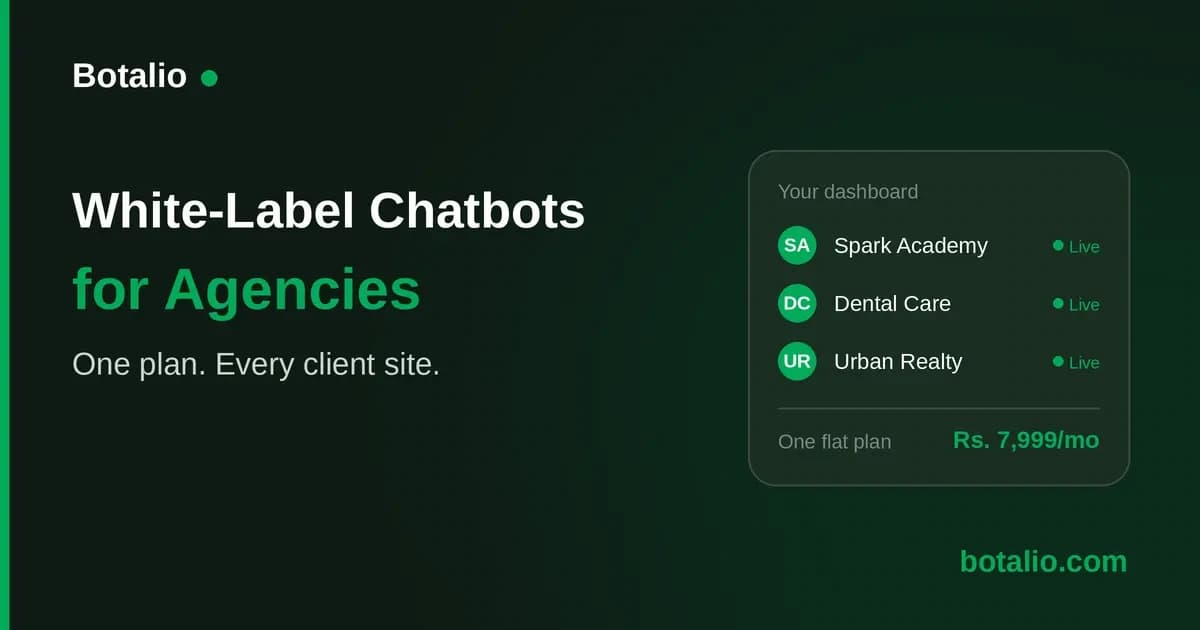
Practically, it involves three things. You manage every client's chatbot from a single dashboard rather than juggling separate accounts. Each chatbot is trained on that specific client's own content, so a dental clinic's bot answers dental questions and a coaching institute's bot answers fee and batch questions. And the branding is yours, which is what makes it a service you own rather than a product you resell.
Why this fits agencies specifically
Most new service lines require hiring. Adding SEO means an SEO person. Adding paid ads means someone who can run campaigns. A chatbot service requires none of that, which is what makes it unusual.
Setup is genuinely fast, you paste one line of code on a site you already have access to and upload content you already have, the client's brochures, price lists and service pages. It is recurring rather than project-based, so it adds to your monthly retainer instead of being another one-off build. It reduces churn, because a client whose enquiries flow through a system you manage is a client who stays. And it is a visible win: when the client starts getting enquiry alerts from their own website, the value is obvious every single month, which is exactly the kind of service that survives budget reviews.
The margin maths
This is the part that decides whether it is worth doing, so here it is plainly. Take Botalio's Agency plan at Rs. 7,999 a month flat, which covers unlimited chatbots across client sites.
Agencies commonly charge clients somewhere between Rs. 4,000 and Rs. 8,000 a month for a managed chatbot service, depending on the client's size and how much hand-holding is involved. Run that against the flat platform cost:
| Clients on the service | You bill (at Rs. 5,000 each) | Platform cost | Your monthly margin |
|---|---|---|---|
| 1 client | Rs. 5,000 | Rs. 7,999 | Rs. -2,999 |
| 2 clients | Rs. 10,000 | Rs. 7,999 | Rs. 2,001 |
| 5 clients | Rs. 25,000 | Rs. 7,999 | Rs. 17,001 |
| 10 clients | Rs. 50,000 | Rs. 7,999 | Rs. 42,001 |
These figures are illustrative, your own pricing will differ, but the shape holds regardless of the numbers you choose. The platform cost is flat while your revenue is per client, so you cross into profit around the second client and every client after that is almost entirely margin. That is the whole economic case, and it is why this works better for agencies than for a single business buying one chatbot.
One honest note: at one client this loses money. So do not sign up for an agency plan to service a single account. Land two or three, then move onto the agency tier.
How to package and price it
The cleanest way to sell this is not as "a chatbot," which sounds like software the client could go buy themselves. Sell it as a managed enquiry service: you set it up, you train it on their content, you keep it accurate as their prices and services change, and you make sure enquiries reach them. The software is the tool; the management is what they are paying you for.
A simple three-part package works well. Charge a one-time setup fee to cover the initial training and deployment, then a monthly managed fee that includes updates and monitoring, and optionally a higher tier for clients with multiple locations or heavier enquiry volume. Keep the monthly fee comfortably below what an extra staff member would cost the client, because that is the comparison they will make in their head.
Pitching it is easiest when you lead with the client's own gap rather than the technology. Most SMB websites lose the majority of their visitors without capturing a single detail, and most enquiries arrive after hours when nobody is available to reply. You can show a client the specific problem on their own site, then show the fix running on it. Our post on why coaching institutes lose admissions to slow replies is a good example of the argument in one vertical, and the same shape applies to clinics, real estate and D2C.
The single most effective sales move is a demo on the client's own website content. Build the chatbot on their real pages, let them ask it the questions their customers ask every day, and the conversation changes from "should we do this" to "when can we start."
What to look for in a white-label platform
Not every chatbot tool works as an agency service. Judge platforms on these:
True white-labelling. The badge must be removable and the branding yours. If the platform's name appears anywhere the client can see, you are advertising your supplier.
Multiple chatbots from one dashboard. Managing ten client accounts separately does not scale. You want every client's bot in one place, each trained separately.
Flat pricing with no per-agent or per-seat fees. Per-seat pricing kills agency margin the moment your team grows. A flat plan keeps the maths above intact.
Trained on each client's own content. A generic bot embarrasses you in front of your client. Each one must learn from that client's documents and pages so the answers are theirs.
Instant lead alerts. Your client should feel the value the moment an enquiry arrives, ideally on WhatsApp with the visitor's name, number and question. That monthly visible win is what keeps the retainer alive.
INR pricing. A dollar-priced platform adds forex cost and exchange-rate drift to a margin you are trying to protect.
Fast, no-code deployment. If each client site needs developer time, the model stops working. One line of code is the standard to hold out for.
Botalio's Agency plan
Botalio was built with this model in mind. The Agency plan is Rs. 7,999 a month flat and covers unlimited chatbots across client sites, all managed from one dashboard, with white-label branding so the service runs under your name. Each client's chatbot trains on that client's own website and documents, so the answers are specific to their business. Leads are captured inside the conversation and alerts go out instantly, including to WhatsApp, so your client sees the value arriving. Pricing is in rupees, AI is included with no per-agent fees, and deployment is one line of code on any site, WordPress, Wix, Shopify or custom, so you can go live on a client site the same afternoon.
If you want to see how it looks before committing, send us one client's website and we will build a working demo trained on that site's content, free. You can show it to the client as your own proposal. The full plan details are on the pricing page, and if you want the underlying cost picture across all tiers, we broke it down in our guide on how much an AI chatbot costs in India.
Frequently asked questions
What does white-labelling a chatbot mean?
It means the chatbot runs under your agency's branding rather than the platform's, with no vendor badge visible to the client. You manage every client's chatbot from one dashboard, each trained on that client's own content, and bill it as your own managed monthly service.
How much can an agency charge for a managed chatbot service?
Agencies commonly charge Indian SMB clients somewhere between Rs. 4,000 and Rs. 8,000 a month depending on client size and support level, often with a one-time setup fee. Since platform cost is flat rather than per client, margin improves with every additional client you put on the service.
How many clients do I need for this to be profitable?
With a flat Rs. 7,999 agency plan and typical per-client pricing, you generally cross into profit around the second client, and every client after that is close to pure margin. It is not worth taking an agency tier for a single account, so land two or three before moving up.
Do I need a developer to deploy chatbots on client sites?
No. A proper white-label platform deploys with one line of code on any website, including WordPress, Wix, Shopify and custom builds. You upload the client's existing content, their brochures, price lists and service pages, and the chatbot is usually live the same day.
How do I pitch this to clients who have never asked for a chatbot?
Lead with their gap, not the technology. Most SMB websites lose the majority of visitors without capturing any details, and enquiries often arrive after hours. Show them that gap on their own site, then show a demo trained on their real content. The demo closes far better than the pitch.
What should I look for in a white-label chatbot platform?
Removable branding, multiple chatbots in one dashboard, flat pricing with no per-seat fees, training on each client's own content, instant lead alerts, INR pricing, and one-line deployment. Miss any of these and either your margin or your client experience suffers.
Will clients just go direct to the platform instead of paying me?
That is exactly why white-labelling matters, there is no vendor name for them to find. Beyond branding, you are selling management, not software: setup, training, keeping answers current as prices change, and monitoring. That ongoing work is what the monthly fee actually buys.
The bottom line
A white-label chatbot service is one of the rare agency offerings that adds recurring revenue without adding headcount. The platform cost is flat, your billing is per client, and the margin compounds as you add accounts. Deployment takes an afternoon, and the client sees the value every month in the form of enquiries they would otherwise have missed.
If you want to test the model before committing to anything, our white-label chatbot for agencies plan is built exactly for this. Send us one client's website link and we will build a free demo trained on that site's own content, so you can put it in front of the client as your own proposal and see how the conversation goes.