Your clients are going to buy an AI chatbot in the next year. The only question is whether they buy it from you or from an ad they saw on Instagram. You already manage their website. You already have their trust. A chatbot is the easiest new line on a retainer you will add this year.
The catch is that most agencies approach this as a reseller problem: find a platform with white-labelling, pay a flat fee, mark it up. That model is harder than it looks, and it is not the one we would suggest.
The short answer
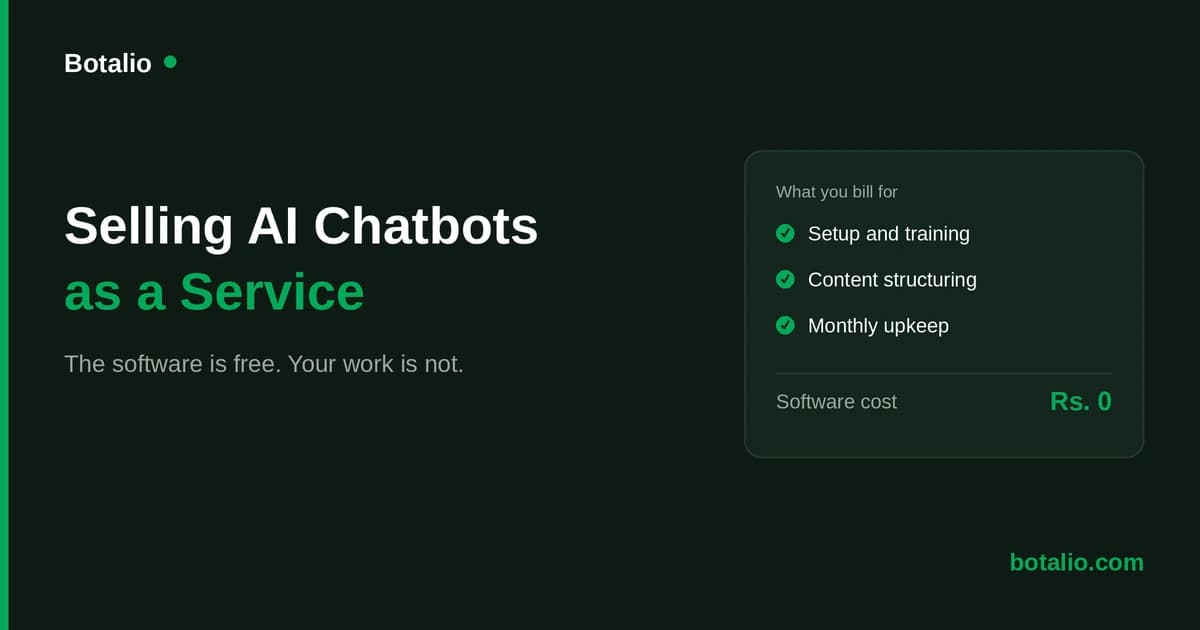
Set the chatbot up inside your client's own account, on a tool that costs nothing, and bill for the work. You are not reselling software. You are selling setup, content structuring, and the ongoing job of keeping the answers right as the client's business changes.
What you are actually selling
Here is the part agencies underestimate. Putting a chatbot on a website is the easy half. Making it answer well is the hard half, and it is the half clients cannot do themselves.
A chatbot trained on a badly organised pile of PDFs gives vague answers and the client concludes the technology does not work. A chatbot trained on well-structured content, written the way customers actually ask questions, answers like a good staff member. The difference between those two outcomes is entirely the work you do, and none of it is visible on a pricing page.
That work is also not one-off. Prices change. Services get added. A new branch opens. Someone starts asking a question nobody anticipated. Every one of those is a reason for the client to keep paying you monthly, and every one of them is invisible to a client trying to do this alone.
Why this fits agencies specifically
You do not need to hire for it. There is no engineering work, no infrastructure, no ongoing technical maintenance. If someone on your team can write a decent FAQ page, they can set up a chatbot.
It is recurring rather than project-based. A website redesign ends. A chatbot service does not, because the content behind it keeps needing attention.
It reduces churn, which is the quiet benefit. A client who gets an email every week with a new enquiry from their website has a visible, countable reason to keep the retainer. Most agency work is not that legible.
The economics, plainly
There is no platform fee to earn back. Botalio is free while the product is early, and each client holds their own free account, so the software costs neither of you anything.
That means the maths is just your fee minus your hours. If you charge a setup fee of Rs. 8,000 to Rs. 15,000 and a monthly of Rs. 3,000 to Rs. 6,000, and setup takes you an afternoon with an hour or two a month afterwards, the margin is obvious enough that it does not need a table.
Two honest notes. First, no platform fee also means no barrier: the client could do this themselves, so what you charge has to be justified by the work, not by access to the tool. Second, Botalio is free while it is early, not free forever. If pricing is ever introduced, existing users hear about it first. Tell your client the tool is free while early rather than presenting it as included in your fee, so nothing lands on them as a surprise later.
How to package and price it
Sell it as an enquiry service, not as software. "We will make sure the enquiries coming to your website actually reach you" is a sentence a business owner understands. "We will deploy an AI chatbot" is a sentence they have to translate first.
Price it in two parts. A setup fee covers the real work: gathering their content, structuring it, writing the answers, testing it against the questions their customers actually ask, and getting it live. A monthly covers keeping it current and telling them what visitors have been asking, which is genuinely useful data most of them have never had.
Lead with their gap, not the technology. Open their site on your phone in the meeting and ask what happens if someone has a question at 9 pm. The answer is usually a contact form nobody replies to until Monday. That is the pitch, and they made it themselves.
Then show a demo built on their own content. The demo closes far better than any deck, because the client asks it their own awkward question and watches it answer correctly.
How the setup actually works
The client creates their own free account. This matters more than it sounds: their leads and their data sit with them, so there is no reseller relationship, no data held on someone's behalf, and nothing to unwind if they ever leave you.
You do the work inside that account. Upload their brochure, price list, service pages or FAQs. Test it. Fix the answers that come out wrong. Paste one line into their website, which works on WordPress, Wix, Shopify or anything custom.
When a visitor shares their details, the client gets an email with the name, phone, email and the question asked. There is also a webhook if they want leads routed into a CRM.
One thing to be upfront about with clients: every chatbot shows a small Botalio badge, and there is no way to remove it. If your pitch depends on the client believing you built the technology, this is not the right approach for you. If your pitch is that you make their website capture enquiries, the badge is a non-issue, in the same way that nobody minds their agency using Google Ads rather than having built an ad network.
Frequently asked questions
What should an agency charge for a managed chatbot service?
There is no standard rate, but a setup fee in the range of Rs. 8,000 to Rs. 15,000 plus a monthly of Rs. 3,000 to Rs. 6,000 is a reasonable starting point for a single-site SMB client. Price it against the hours the content work takes, not against a platform cost, because there is not one.
Can I manage all my clients from one dashboard?
Not on Botalio. Each client holds their own account with their own login, so their data stays with them. You work inside each client's account rather than running them all from one place.
Can I remove the chatbot's branding for clients?
Not on Botalio. Every chatbot shows a small badge and there is no way to turn it off. What you are selling is the setup and the ongoing work, not the software itself.
Do I need a developer to deploy chatbots on client sites?
No. It deploys with one line of code on any website, including WordPress, Wix, Shopify and custom builds. You upload the client's existing content and the chatbot is usually live the same day.
How do I pitch this to clients who have never asked for a chatbot?
Lead with their gap, not the technology. Most SMB websites lose the majority of visitors without capturing any details, and enquiries often arrive after hours. Show them that gap on their own site, then show a demo trained on their real content. The demo closes far better than the pitch.
Will clients just go direct and cut me out?
Some might, and that is worth being honest about. What stops it is that the tool is not the valuable part. Anyone can create an account. Structuring the content so the answers are actually good, and keeping them right as the business changes, is the work, and it is the same reason clients pay you to run their ads rather than logging into Google themselves.
What are the limits on a client account?
Each account gets 500 conversations per calendar month, 2 chatbots, and 5 knowledge base documents per chatbot, with a 3 MB limit per document. That is comfortable for a single business website.
The bottom line
The reseller version of this business, where you pay a platform fee and mark it up, is not the only version and probably not the best one. When the software costs nothing, what you sell is the thing you were always better at than the tool vendor: understanding the client's business well enough to make the answers good.
Set one up for your first client, trained on their own content, in an afternoon. See what they say when it answers their own awkward question correctly. Then decide what that is worth on a retainer.
If you want to see what a chatbot looks like on a business like your clients', the AI chatbot service for agencies page walks through the setup, and our guide on how much an AI chatbot costs in India covers what the market actually charges.